
Service design
Lung cancer is never a good experience
Care improves when the whole journey becomes visible.
- Industry
- Healthcare and patient support
- What we did
- Patient research, journey mapping and service design
01
The treatment is medical. The experience is everything around it.
Every year, around 800 people in Estonia are diagnosed with lung cancer. Alongside the disease itself, patients and their families face fragmented information, emotional strain and gaps in support.
A hospital can treat a tumour. A patient, meanwhile, has to navigate appointments, tests, results, decisions, systems and fear—often without knowing what happens next or who is supposed to know.
Our task was to understand that entire journey, from the first symptoms through treatment and beyond, and find where the system could behave more like one system.
02
Listen before prescribing
We spoke in depth with patients and their families about the emotional and practical realities behind the clinical pathway. Their experience revealed what process diagrams tend to omit: uncertainty, repetition, waiting and the exhausting job of joining up information yourself.
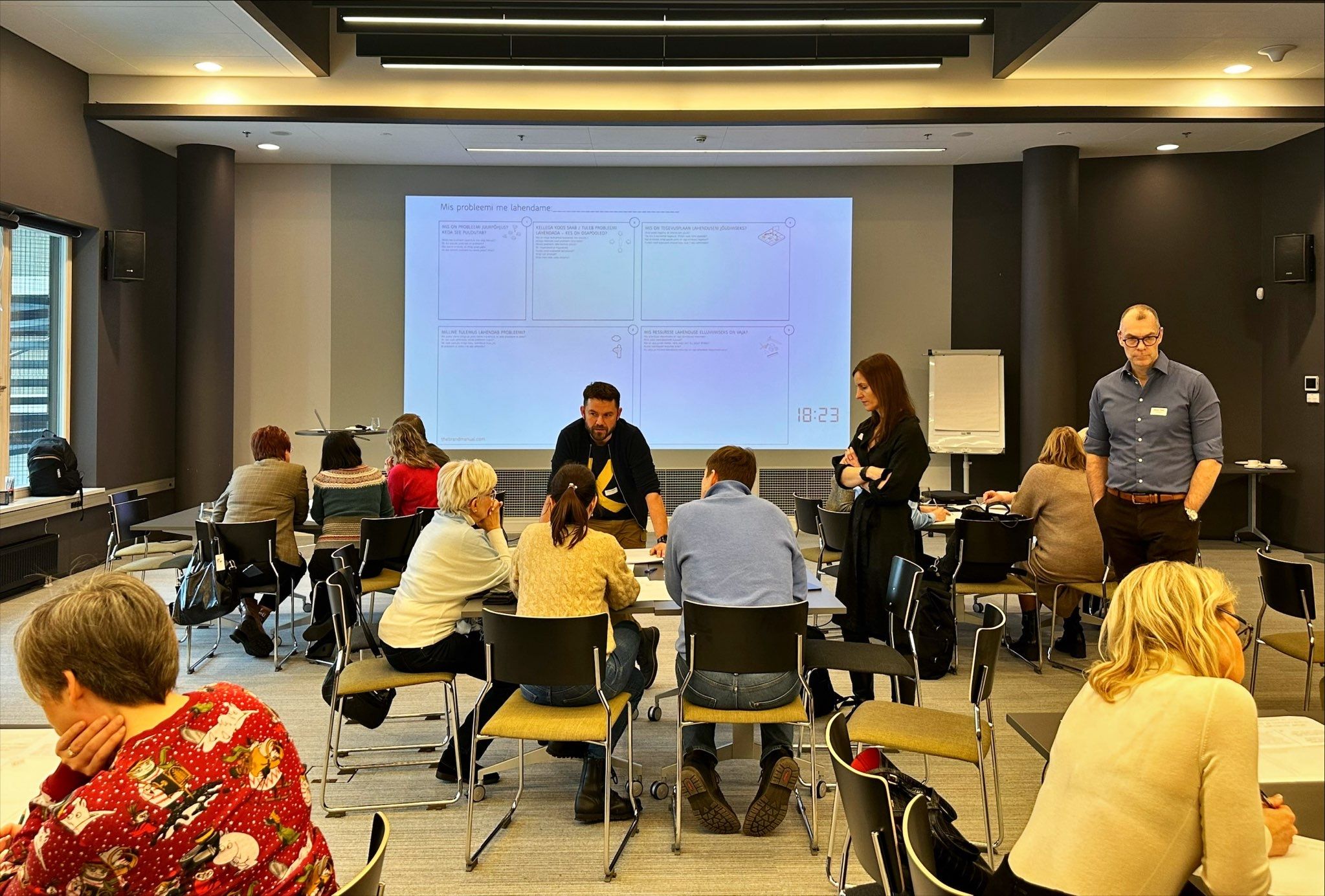
Collaborative workshops then brought hospitals, patient organisations, healthcare providers, pharmaceutical companies and public bodies into the same room. This mattered. Everyone held part of the answer; nobody held the whole journey.
Together, we mapped the overlaps and the gaps between what patients need and what the healthcare system currently provides.
03
Fifteen places to make care more caring
The work identified 15 concrete opportunities for improvement—from how a diagnosis is delivered to clearer communication, better support platforms and more coherent sharing of patient information.
The findings have already inspired new initiatives, including a patient-friendly dashboard and tools for connecting data more effectively. None of these makes lung cancer a good experience. That was never the claim. They can make an impossibly difficult journey less confusing, less fragmented and less lonely.
The project created a shared foundation for systemic improvement: not a new promise to patients, but practical places to start keeping one.
Many hands, one journey
Co-creation was not a workshop flourish. It was the project.
This work brought together service designers, journalists, hospitals, patient organisations, pharmaceutical companies and government bodies, including ReThink, Regina Tagger, Justin Petrone, Pfizer, Roche, MSD, AstraZeneca, Tervisekassa, the Ministry of Social Affairs, Tartu University Hospital, PERH, ITK, Tartu City, Saaremaa Cancer Association, MTÜ Pallium, Pärnu Hospital, the Viljandimaa cancer support group, the Estonian Lung Association, Estonia’s young family doctors, West Tallinn Central Hospital and the National Institute for Health Development.
The point